Powered by Blogger.
Showing posts with label Water Softener. Show all posts

Monday, April 1, 2019

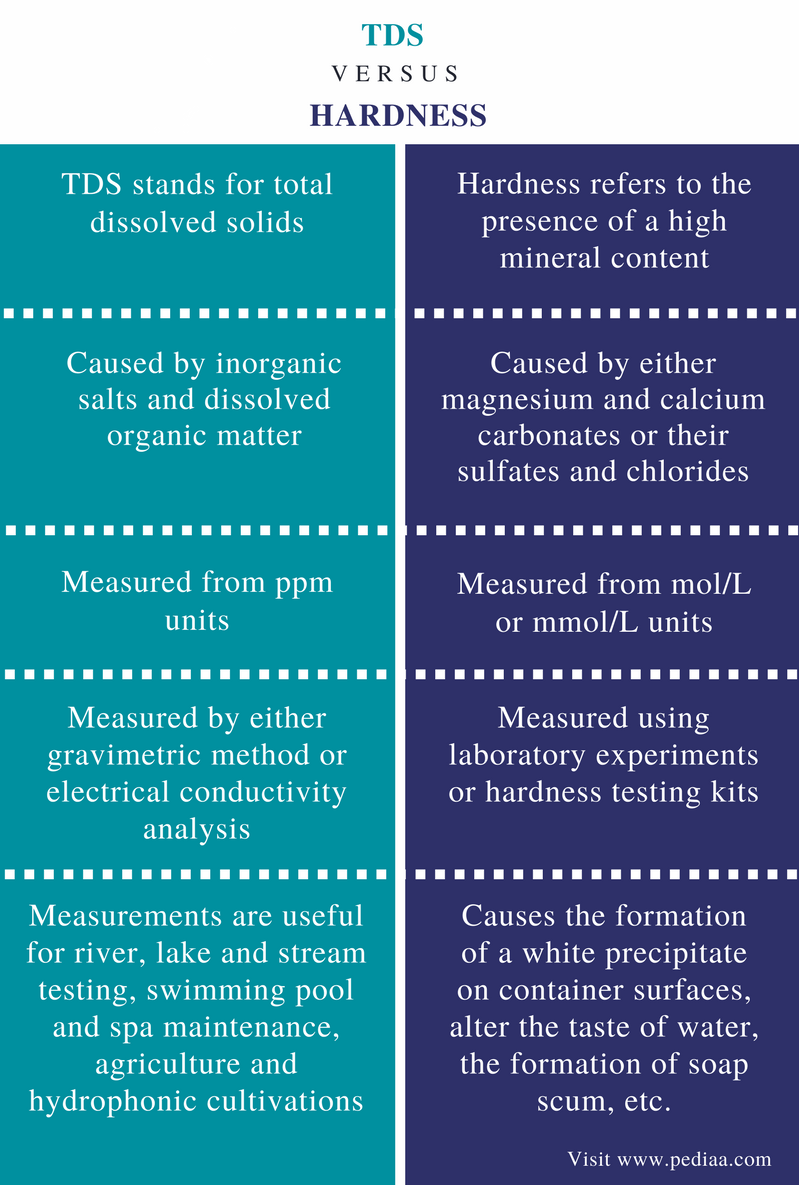
TDS VS Hardness

It seems that the terms TDS and Hardness are often confused.  

We measure the water coming from the RO system for TDS and compare it to the TDS reading coming from the water source.  The formula is:

Incoming - Outgoing / Incoming

A 90% rejection rate or better means that the membrane on the RO system is working.

Hardness is used to measure if the water softener is working.  Knowing how hard the water is before running through the softener is the key to knowing if the water softener is working.  A reading of one grain of hardness is considered soft, but if the reading is lower grains than the incoming water, the softener is doing its job.  It is important to find out the average readings in your area.

Here is a handy chart to help compare the two readings.

Related image


Tuesday, September 5, 2017

The science of a water softener. How does it really work??

Well for starters you have to know how a water softener works.


How a water softener works is through a process called ionic exchange. Inside the water softener tank is a media called resin. When water passes through this media hard water minerals stick to the resin and leaves the water "soft". Check out one of our earlier blogs for some further information on how they work.

...well why do the hard water minerals stick to the resin?

Well this all comes down to the molecular level. When you get down to the molecular level you will hear of an ion having a particular charge in order to form a bond. In this case resin has a negative charge and the hard water minerals Calcium (CA++) and Magnesium(MA++) have a positive charge, but more importantly resin under a microscope looks like a ball of mesh. This is how the resin will catch these hard water minerals. These ions are charged such that they are drawn towards one another and the mesh of the resin aids in that as well. First the resin holds onto the sodium chloride (NA+) but once the resin comes in contact with hard water minerals, the sodium is detached and the Calcium and Magnesium are exchanged due to their more powerful positive charge. Refer to the picture below.


If you would like to have your water tested for hardness, cruise on over to our shop. We are located on 2775 Kiowa Blvd. North. Make sure to bring your water in a glass jar to get a more accurate reading. We'll even test your water on our site for free!

Friday, August 4, 2017

How does the Regeneration Cycle work?

If you have a water softener system then you've probably heard about the regeneration cycle. One common question we get all the time here at PB&J Water is how does it work?

...when does the water softener regenerate?

In our last blog we discussed how a water softener would need to regenerate after 11 days in relation to the grain rating. However a water softener regenerates after gallons used which is usually 800 gallons with a standard system. So if 800 gallons have been used then the system will regenerate at 2am. So if you continue to use water after 11 days and your system hasn't regenerated then you wouldn't get "soft" water anymore because the resin already has hard water minerals bonded to it. That's why it would NEED to regenerate to prolong the life of the resin and to ensure your house is getting soft water.

Today we will briefly discuss the Regeneration cycle, the different steps, and what they do.

Cycles of the regeneration process


Backwash/Rinse (10 minutes)
  • The softener changes the flow of water by pushing water down the distributor and this forces the water up through the media and out to the drain line.
  • Dirt and sediment also get removed during this process.


Brine Rinse (60 minutes)
  • This is when the salt is added to the resin tank where it will stay until the next regeneration.
  • The salty water is drawn out of the bottom of the brine tank to the resin tank. Once this water washes over the resin this is when the ionic exchange happens. Once the salty water comes in contact with the resin, the hard water mineral is let go in place of the salt due to the salt having a slightly positive charge. The minerals are then washed down to the distributor through the tube in the middle and out through the drain line. This step could also be referred to as the recharge cycle.


Rapid Rinse (6-8 minutes)
  • Water washes the resin to remove excess salt but leaves enough for the softener to be in service. 


Settle Rinse (5 minutes)
  • During this step the mineral bed is repacked to ensure proper flow during operation.


Brine Refill (6-8 minutes)
  • This is the last step in the regeneration cycle. The brine tank gets refilled with water for the next regeneration cycle, then you are back in service.


If you have any questions regarding your water softener give us a call at 928-706-0546 and we would be happy to answer them for you. Also remember to pick up softener salt at our location if your getting pretty low, in fact we could even deliver it to your address!

Thanks for reading! Next time we will go over the science of a water softener system so stay tuned!


Wednesday, April 19, 2017

The dangers of having your Water Softener outside!


            Water softeners provide a service almost immeasurable to your homes fixtures, your clothing, your skin and your dishes. These systems protect your investment. So why not be nice to them?
            A water softener system is most commonly installed in your garage however, there are times when the system has to be installed outside due to your plumbing. In mild climates as well as harsher climates this would still be a danger to your system especially if the sun is shinning directly on it. The sun and heat can dry rot your salt tank and can cause your salt to bridge. The salt in your tank will form together making a bridge above your water, which will make your softener not absorb the salty water necessary for the regeneration process.
          Having your system outside can cause your resin tank to warp and potentially cause a leak from where the meter head is connected to the resin tank. A water softener can last up to 10 years if you treat it right. Placing your system in an area where the sun is not directly on it ensures the life of your water softener.
         Remember this when purchasing a system to be installed, you might need a plumber to reroute your plumbing from outside to the garage. Another idea is to build an enclosure for your system if it is outside.
         If your thinking about protecting your investment consider purchasing a water softener, we could even install one for you. If you currently have a water softener system that needs service give us a call! We'd be happy to answer any questions you have as well.

Thursday, February 16, 2017

Catch us at Rockabilly this year!


This weekend through Sunday is the Rockabilly Reunion. Bring your family on down and listen to some live music. There will be vendors with food and refreshments so your covered. We will be there.

We'll even have a booth set up! Here's when:

Friday: 11am to 8pm
Saturday: 10am to 8pm
Sunday: 10am to 7pm


In fact our name will be on the second stage. Last year we even had a raffle which was a huge hit. People won complete Reverse-Osmosis systems, and Water Softener systems from a wheel which people were allowed to spin. We are bringing back the spinning wheel, so stop by to win some cool prizes. We will be selling ice cold bottled water in which the proceeds will go towards the Clothe-A-Child charity.


Check out the Rockabilly Reunion website for more information on vendors and celebrity performances.

Thursday, March 10, 2016

Rockabilly Winners!


PB&J Water would like to extend out congratulations to all the winners at the 2016 Rockabilly Event.  PB&J gave away several ROs and Water Softeners during the event.


And a big Congratulations to our General Manager, Julie, who was the Grand Prize winner of the Rockabilly Pin-Up contest!

Rock On!

http://pbjh2o.com

Wednesday, August 26, 2015

Happy Labor Day!


Did you know PB&J has a 
no interest Rent To Own option 
for local customers in Lake Havasu City, AZ?


Email or call 928-706-0546 to ask about it.

Tuesday, May 12, 2015

2 Steps To An Awesome Shower

There are only two steps to an awesome shower.

Wednesday, April 8, 2015

Did You Know?


Did you know that besides installing and maintaining water softeners and RO systems in homes in the Lake Havasu City area and beyond, that PB&J Water installs and maintains systems commercially all over the United States as well?  You might recognize some of our customers . . .


No matter if you have a business that needs filtered or conditioned water or if you need an RO or water softener installed in your home, PB&J Water can meet all your needs.


Tuesday, March 17, 2015

What To Expect When You Get A Water Softener


Before we had our water softener installed, our bath time looked like that dog avoiding the bath.  Our fixtures were corroding, dishes spotty, skin drying, etc.  so we decided to have the water softener installed to fix these problems.

Friday, March 6, 2015

De-Stress This Weekend


Take time this weekend to de-stress in a bath filled with softened water from a PB&J water softener.

Tuesday, October 7, 2014

How A Water Softener Works

Have you ever wondered how a water softener works?  Here's a simplified explanation . . . 


And here is how a water softener regenerates . . .


Did you know PB&J has a no interest Rent To Own option for local customers in Lake Havasu City, AZ?  Email or call 928-706-0546 to ask about it.

Tuesday, September 30, 2014

What about "No-Salt" Water Conditioners?

The new whole house water conditioners are all the rage. Infomericials about them promise low maintenance, no salt softened water.  But can you really stop buying salt and get the same results as you get with a traditional water softener?

The advertising for a no-salt system draws you in.  Who wouldn't want to stop buying salt?  But what the advertising doesn't tell you is that you will not get the same sustaining results without the salt.

The “No-Salt” type systems include magnets, electro-magnets, electrical frequency, and crystallization polymers. All of these systems claim to change the structure of hardness minerals that prevents scale from forming.  Many have only supplied information that is generated from within their companies. Some may refer to “Customer Successes”, but it is being reported from within.

The main problem with all no-salt systems is that you can’t verify that they are doing anything. There is not a test that can show a difference in water before and after the treatment. There is not a detectable difference in the feel of the water, the reaction with soaps, or with laundry. The water before and after the treatment is the same.

So that leaves you with one claimed benefit, scale prevention. The problem with this is that you can’t see inside of the plumbing. So you can’t know if it is having any effect on scaling. You are left to have faith that scale is not forming inside your plumbing. You can’t see it, verify it, or prove the PWC is working. If you disconnect a water softener, and install any PWC, you will immediately get white crust forming all over your fixtures. You will also immediately lose the soft water feel while bathing.

Water Softener System PB&JThe use of salt is a great tradeoff to problems caused by hard water. Soft water reduces energy consumption used to heat water, saves appliances from un-necessary wear, reduces soaps, and eliminates the need for harsh cleaning products. These claims are not internally generated, hyperbole, they are known facts and confirmed by various third party testing. All of these benefits are achieved with something natural we get from the ground called salt.

In summary, dig deep for the facts. If you want soft water, you can’t get it from “No-Salt” water conditioners. If you love soft water, and you want minimal salt consumption, and you still want to get a great shower, it can all be done with a water softener from PB&J Water.
Tuesday, September 23, 2014

Water Softener Systems

Hard water is water that is contaminated with dissolved minerals:

Calcium, magnesium, sulfur, iron, lead and limestone – these can have a negative impact on you, your household and your pocketbook. Depending on where you live, contaminants from sewage, industrial waste and agricultural run-off can also seep into your water supply.

Hard water produces scale:

If there are stains or buildup on your sinks and bathtubs, if you have to use large amounts of soap to clean dishes or wash your hair or if your water tastes or smells odd, you probably have hard water. If left untreated, the minerals in hard water will cause yellow stains on plumbing fixtures and be deposited as scale, eventually clogging plumbing and shortening the life of appliances like washing machines, water heaters and dishwashers. Scale deposits not only cut down on the efficiency of these appliances, they cost you money, increasing both energy and maintenance bills.

Clack Water Softener SystemWater softeners eliminate the effects of hard water:

They “soften” the water by removing the calcium and magnesium found there, extending the useful life of water heaters, washing machines, dishwashers, coffeemakers, humidifiers and household plumbing systems by as much as 30%.
Have questions on how a water softener will benefit your home?  Contact us today! 855-4PBJ-H20 or 855-472-5420
Related Posts Plugin for WordPress, Blogger...
 

PB&J Water

PB&J Water specializes in providing and installing the right equipment for our customer’s needs. We service restaurants, laundromats, car washes, and residential. No job is too big or small.

Contact Info

2880 Sweetwater Ave
Lake Havasu City, AZ 86406
Phone - Toll Free: 855-472-5420
Fax: (928) 680-9190
Texting: (928) 351-7435
Email: info@pbjh2o.com
Website: pbjh2o.com